Understanding Radio and Paging Interfaces in IP Communication Systems
Learn how RoIP, paging adapters, amplifiers, online radio, and telephone interfaces work together in modern IP communication systems.

Estimated reading time: 8 minutes
Overview
As facilities embrace IP communication equipment into their ecosystem, they rarely start with a blank slate; existing business-critical systems are in-place and relied upon by building occupants.
Radio systems, analog paging amplifiers, speaker zones, telephone-style paging interfaces, and newer IP endpoints may all exist and will need to continue working together to ensure existing processes are not disrupted.
The challenge is not simply deciding between “IP” and “analog.” It is understanding how these systems connect, where the transition between technologies occurs, and what each interface is expected to do.
Terms such as Radio over IP (RoIP), online radio streaming, paging adapter, amplifier, and telephone port describe different parts of that communications architecture. Separating these concepts makes it easier to understand how existing communication infrastructure can be integrated with SIP-based VoIP and Unified Communications (UC) environments while allowing organizations to retain and reuse appropriate existing equipment rather than assuming every function requires a separate or entirely new system.
RoIP and VoIP: Where Do They Intersect?
Voice over IP (VoIP) describes voice communication carried over an IP network. SIP is commonly used to establish and manage communication sessions, while RTP is commonly used to carry real-time audio.
These functions are defined in the IETF SIP specification, RFC 3261, and RTP specification, RFC 3550.
Radio over IP (RoIP) addresses a different part of the communication path. It enables radio communications to be transported or interconnected over an IP network, typically via hardware or gateways that interface with the radio system.
The distinction matters because a radio is not automatically a SIP endpoint. The radio side may still require analog or digital audio connections, push-to-talk control, or other radio-specific signaling before communication can be connected into an IP environment.
NIST has examined this type of interworking when connecting land mobile radio systems with IP-based mission-critical push-to-talk communications. NIST’s research on LMR and IP interoperability illustrates the role of an interface that bridges otherwise different communication systems.
For facility communication, IP provides the network connection, while a compatible adapter can link VoIP/UC, radio, and paging systems, allowing audio to pass between these different communication environments.
Online Radio Streaming vs. Handheld Radio Integration
Let’s get one nomenclature issue out of the way. In a modern IP audio system, we have two very distinct operations referred to as radio: online radio streaming and handheld radio integrations.
Online radio streaming refers to receiving an audio stream from an Internet-accessible URL. The stream becomes an audio source that can be distributed to compatible endpoints, typically for background music or other program audio.
For example, supported Algo paging adapters can receive an online audio stream and multicast that audio to compatible IP endpoints. This allows a single device to serve as the audio source for multiple devices on the network.
Learn more about streaming online radio to Algo IP devices →
Handheld radio integration connects an operational radio communication system. Depending on the radio system, that may involve a base station, donor radio, audio input/output, push-to-talk control, or another radio-specific interface.
The objective is different from online streaming. Handheld radio integration allows operational voice traffic to pass between radio users and other communication systems.
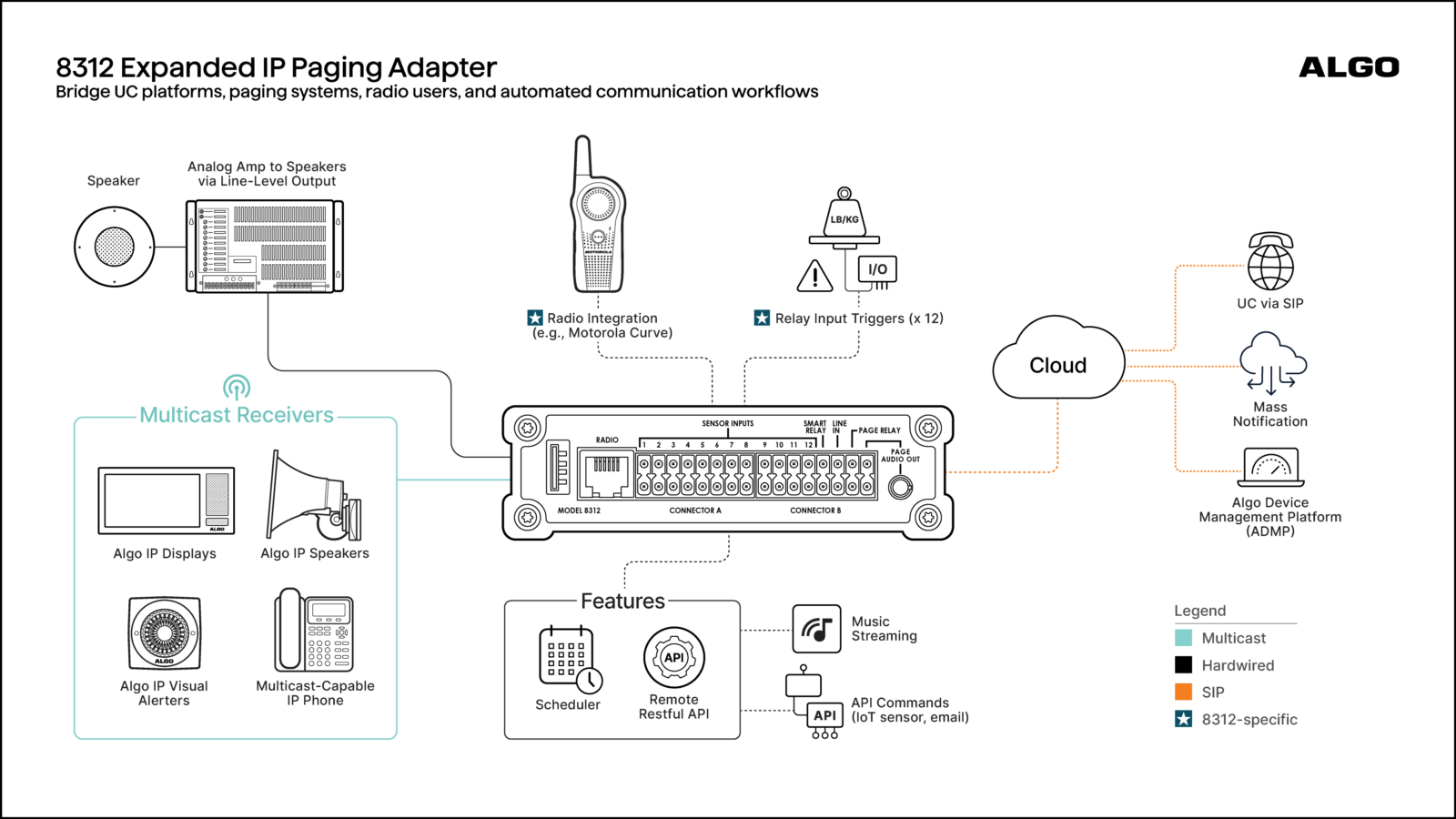
For example, an IP paging adapter may receive communication from a SIP-based UC environment and pass audio to a connected radio system. In other configurations, radio audio may be passed to a paging or PA System.
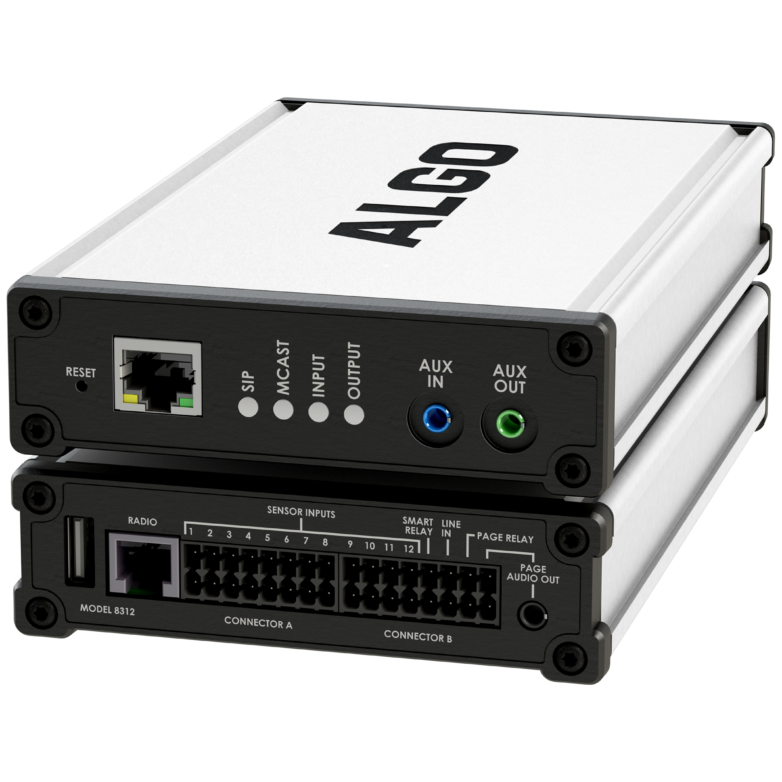
The Algo 8312 Expanded IP Paging Adapter supports direct integration with compatible base-station-free handheld radios, while radio systems using a base station may use other audio-interface configurations.
Learn how the Algo 8312 bridges SIP paging with compatible base-station-free radios →
The important distinction is therefore not which type of radio integration is “better,” but what each one is designed to do.
Online radio is an audio source, while handheld radio integration connects an operational communication system. Both can coexist with paging, multicast, amplifier connectivity, and other capabilities within the same IP audio environment.
Paging Adapters and Amplifiers: Two Roles in the Same Signal Path
Paging adapters and amplifiers are also sometimes treated as alternatives when they perform different functions.
A paging adapter provides an interface between communication environments. It can receive audio or signaling from a VoIP system and provide the audio, control, or interface required by existing paging infrastructure.
An amplifier supplies the electrical power that drives traditional analog speakers.
In a typical hybrid paging system, the signal path may look like:
SIP/UC platform → IP paging adapter → existing amplifier → analog speakers
The paging adapter connects the IP communication system to the existing paging infrastructure. The amplifier continues to power the existing analog speakers.
These roles do not prevent the paging adapter from performing other functions simultaneously. Depending on the device and configuration, the adapter may also send or receive multicast, play scheduled audio, accept other audio sources, or distribute communication to IP endpoints.
Algo paging adapters provide different physical interfaces for different legacy environments.
For example, the 8301 is commonly used with traditional amplifiers, the 8305 provides additional interfaces for legacy telephone-style communication systems, and the 8373 is designed to create zones behind an amplifier. All three share core IP paging capabilities.
Telephone-Port Paging: When Audio Alone Is Not Enough
Some legacy paging systems cannot be integrated through a conventional line-level audio connection alone.
Instead, they expect an interface that behaves like an analog telephone connection.
Traditional analog telephony uses interfaces commonly described as FXS and FXO. An FXS interface provides the line functions such as talk battery and ringing, while FXO interface connects to that line and behaves like a telephone by going on-hook or off-hook.
Cisco provides additional background on the operation of FXS and FXO analog ports.
This matters in paging because some legacy amplifiers or communication systems provide a talk-battery or telephone-style interface instead of, or in addition to, a conventional audio input.
In these environments, simply sending audio to the paging system is not enough. The connected device may need to behave like a telephone by seizing the line, go off-hook, transmitting DTMF digits, and then sending the paging audio.
The Algo 8305 Multi-Interface IP Paging Adapter provides this type of interface. Its telephone port can emulate an analog telephone when connected to a talk-battery interface of a compatible legacy system while the 8305 remains a SIP and multicast endpoint.
This illustrates a broader point: two paging systems may serve the same basic function but require completely different interfaces to receive or initiate a page.
Start With the Interface, Not a Single Feature
When evaluating an existing radio or paging environment, it is more useful to identify the communication path and system interfaces than to classify the project as a single integration type.
Consider four questions:
- Where is the audio or communication originating? It could be a SIP call, a UC platform, an Internet audio stream, a handheld radio system, a microphone, a stored audio file, or another source.
- How does that communication need to move through the IP environment? SIP, RTP multicast, APIs, or another mechanism may be involved, depending on the workflow.
- What interface does the existing equipment provide? This could be a line-level amplifier input, a telephone/talk-battery interface, radio audio and control connections, or an amplified speaker-zone circuit.
- What existing infrastructure needs to remain in use? An organization may want to retain its amplifier, analog speakers, speaker zones, radio system, or a combination of these while adding IP communication.
More than one answer can apply at the same time.
A single deployment might receive a SIP page, send it through an existing analog amplifier, multicast the same communication to IP speakers, and also support background audio from an online stream. Another might add a handheld radio interface to that environment.
This is why integration should be evaluated as a signal-path and interface problem rather than as a list of mutually exclusive features.
Connecting Existing Infrastructure to IP Communications
Introducing IP communications does not necessarily require removing infrastructure that still serves its intended purpose.
The role of an IP paging adapter is often to provide the connection between the IP communication environment and existing systems already deployed throughout the facility, including paging amplifiers, analog speakers, radio systems, and specialized legacy interfaces.
The appropriate architecture depends on what each system sends and receives, how those systems connect, and what the interface between them must do.
Understanding those interfaces first provides a clearer basis for integrating radio, paging, and analog audio with SIP-based communications while retaining existing infrastructure where it remains useful.
Want to learn more about the various paging adapter models Algo offers?
View Algo Paging Adapter Comparison →
Key Takeaways
- Understanding the differences between Voice over IP (VoIP) and Radio over IP (RoIP) is crucial for effective integration.
- Both online radio streaming and handheld radio integration serve distinct purposes in an IP audio system.
- Paging adapters connect VoIP systems to existing paging infrastructure, while amplifiers power traditional analog speakers.
- Evaluating interfaces and existing infrastructure is key to successfully integrating IP communication without replacing functional systems.
FAQs
Is RoIP the same as VoIP?
No. VoIP broadly refers to transmitting voice over IP networks. RoIP applies IP networking to radio communications and requires an appropriate interface to the radio system.
Is online radio streaming the same as handheld radio integration?
No. Online radio streaming receives program audio from an Internet stream, while handheld radio integration connects an operational radio communication system. They serve different functions and can exist within the same IP audio environment.
Does a paging adapter replace an amplifier?
Typically, no. A paging adapter provides the communication interface, while an amplifier supplies the power and amplification required by traditional analog speakers.
Why would a paging system need a telephone-port interface?
Some legacy paging systems expect analog telephone behavior rather than only a line-level audio signal. A compatible paging adapter can emulate functions such as line seizure, off-hook operation, DTMF signaling, and one-way paging audio.